


Introduction of TC-mAb™ mouse
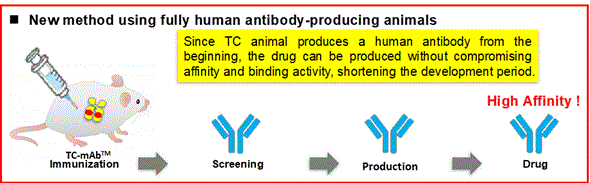
In human antibody production, the immunization method using transgenic mice has the advantage of producing affinity heavy and light chain pairs in a natural way in the animal's body.
Trans Chromosomics (TC) has developed the TC-mAbTM mouse using a proprietary artificial chromosomal vector as a tool for rapid discovery of antibody drugs.
TC-mAb™ mice harbor the full-length human immunoglobulin heavy-chain genes as well as the variable and constant regions of the human κ light chain, which has the most extensive track record in therapeutic antibody development. As a result, they generate a highly diverse repertoire of fully human antibodies that closely resembles the diversity observed in the human immune system.
*Support for human λ light chain antibodies is available upon request.
Establishment procedure of TC-mAb™ mice
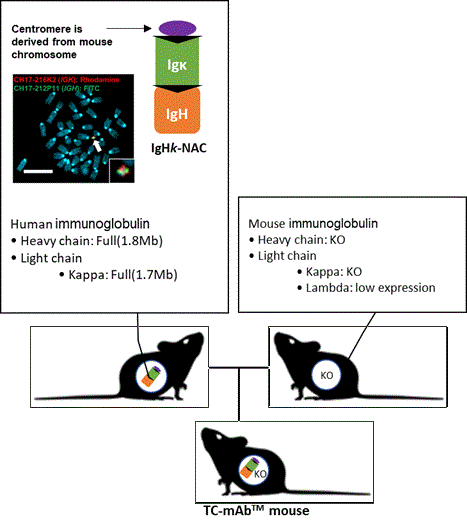
The novel artificial chromosome (NAC) is a vector having a minimal function and structure as a chromosome by removing the gene region from a natural mouse chromosome. It is possible to introduce Mb size giant genes and multiple genes. The artificial chromosome is maintained stably in the cell and is transmitted to offspring in mouse.
Key Features of TC-mAb™ Mice
Antibodies derived from conventional human–mouse chimeric antibody-producing mice require replacement of the constant region to generate human antibodies. In contrast, TC-mAb™ mice produce fully human antibodies. In addition, TC-mAb™ mice are characterized by their ability to efficiently generate antigen-specific B cells.

Production efficiency of antigen-specific mAbs
For the same antigen, TC-mAb™mice can provide mAbs that recognize much more antigen (EpCAM) than WT mice.
However, for some antigens, the immune response may be delayed, requiring 2-3 additional immunizations.
Recently, we have developed and optimized an immunization method for TC-mAb™mice that reduces the immunization period to about 40 days! Multi-pass membrane protein is also available.

Antibody sequence variability of repertoire in TC-mAb™ mice
The recombination frequency of V(D)J is also well reproduced in humans.


The use of functional V-segments without significant bias (>10%, red line) contributes to the expression of diverse mAbs.
CDR3H length is closely similar with hPBMCs, suggesting that the production of human Abs is recapitulated in TC-mAb mice.
TM
Somatic hypermutation is detected in regions including CDR regions

Somatic mutations (SHM) produced by immunizing TC-mAb™ mice are frequently found in the CDR1, 2, and 3 regions.
Higher percentage of plasmablasts and plasma cells

TC-mAb mice show phenotypes such as low absolute number of spleen cells, but...
Surface marker analysis of B cell-development reveals that plasmablasts and plasma cells are well differentiated in TC-mAb™mice.
This may explain the higher efficiency of antigen-specific mAbs production in TC-mAb mice.
TM
Reference
Efficient human-like antibody repertoire and hybridoma production in trans-chromosomic mice carrying megabase-sized human immunoglobulin loci
Nat Commun. 2022 Apr 5;13(1):1841. doi: 10.1038/s41467-022-29421-2.
PMID: 35383174